I avoided Carrie Soto Is Back for years.
Which is funny, because Taylor Jenkins Reid rarely misses for me. I’m a fan of her works. I enjoyed Malibu Rising, Daisy Jones and The Six, and of course, the iconic The Seven Husbands of Evelyn Hugo.
But something about Carrie always pushed me away. Maybe because the first time I encountered her was in Malibu Rising, where she was “the other woman.” So somewhere in the back of my mind, I’d already judged her before she had a chance.
Lately, though, I needed a break from the usual murder mysteries and psychological thrillers that I read. They’re my cup of tea, but sometimes they drain me. I wanted to read something lighter, so I finally decided to give Carrie Soto a chance.
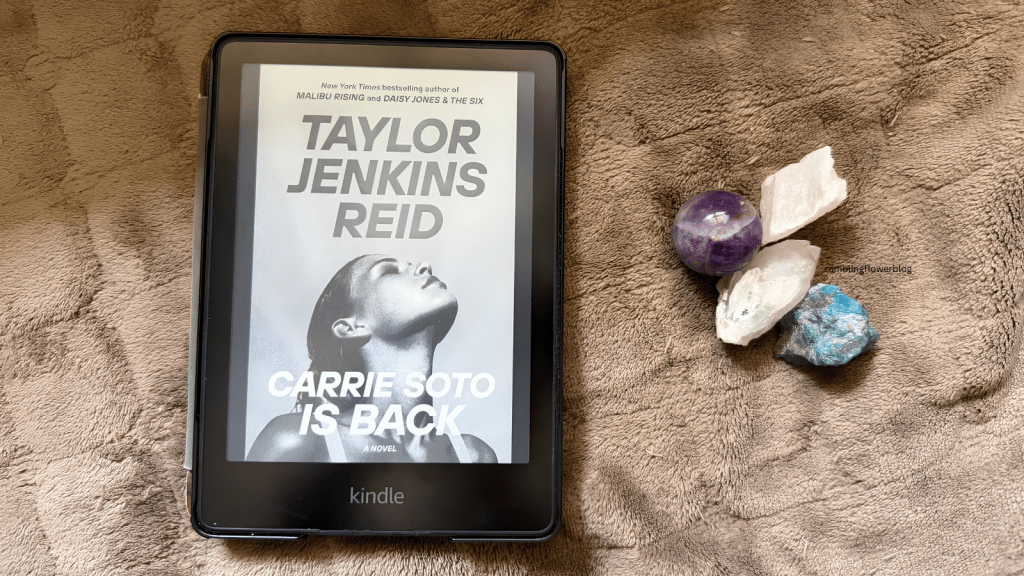
The book follows retired tennis legend Carrie Soto, who returns to the court after a younger player threatens to break her long-standing record. It’s set in the 80s and 90s, a time when female athletes were expected to carry excellence and softness.
Carrie is a complex character. She’s layered, sharp, and intense. Emotionally armored in ways that make her hard to love and impossible to look away from. There were moments I wanted to hug her, and moments I wanted to slap her (with love, of course).
Halfway through the book, I was invested and genuinely enjoyed the story. I even asked myself, Oh my god. Why did I wait this long to read this?
The answer arrived later.
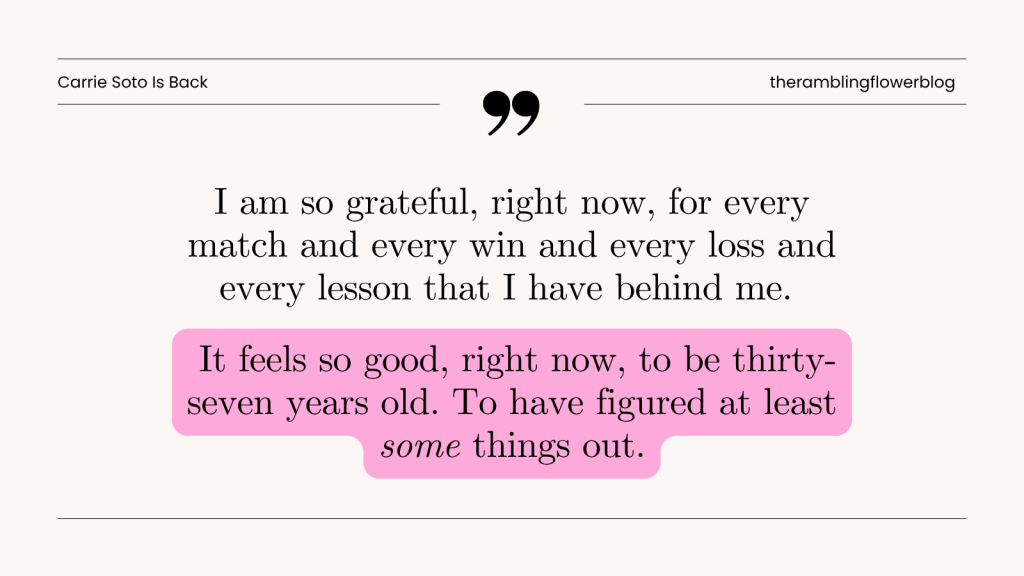
There’s a passage where Carrie reflects on being 37. She says she’s grateful to be this age. That at least now, she understands certain things, and that you couldn’t pay her to go back to being younger and clueless.
I just sat there staring at the page.
I’m 37 too. And for some reason, that hit me harder than I expected.
You see, I know 37 isn’t that old, but there’s a certain weight in my late thirties that I don’t always talk about.
I can feel that my body needs more care and nourishment than it used to.
I notice that the skin around my eyes and mouth no longer smooths out as quickly as it once did.
I’m aware that younger people seem limitless in ways I no longer do.
And I know that some dreams now have a timeline.
Those are the parts that are easiest to see. It’s easy to focus on what aging is taking.
What’s harder is noticing what it’s given.
My twenty-something self was younger and faster, yes. But she was also clueless and uncertain of so many things. She spent so much time trying to become someone, to prove herself, and to figure out what mattered and what didn’t.
I wouldn’t trade places with her. But becoming older has also made me kinder toward her.
For a long time, I looked back at certain chapters of my life with embarrassment. Sometimes frustration.
Why did I stay so long? Why did I make that decision? Why couldn’t I see what seems so obvious now?
At 37, I don’t ask those questions with the same sharpness anymore.
I can look back with softer eyes now.

Not because I think everything happened for a reason. I don’t. Sometimes things are unfair. Sometimes people hurt us. Sometimes life is random and disappointing and doesn’t offer a lesson neatly wrapped in a bow.
But age has allowed me to look back with more compassion for the version of me who was living through those moments.
She didn’t have the experiences I have now. She hadn’t learned the lessons yet. She was simply trying to make sense of her life with the tools she had at the time.
And when I look at her now, I don’t see someone foolish. I see someone trying.
Trying to love, trying to belong. Trying to build a life, trying to figure things out.
Maybe that’s one of the unexpected gifts of getting older. Not wisdom exactly, but perspective.
I’m close to forty, and I don’t have everything figured out. But I understand a few things now that I couldn’t have understood then.
I’m aware of what deserves my energy and what doesn’t.
I know that not every opportunity is meant for me.
I understand that peace is often more valuable than being right, impressive, or endlessly productive.
I’ve learned to recognize what’s within my control, and to let go of what isn’t.
And perhaps most importantly, I can finally see how much I’ve changed.

That’s the strange thing about growth. When you’re living through it, it rarely feels dramatic.
Most days feel ordinary. You go to work, get your fave coffee, eat with your family, worry about things. Then try again tomorrow.
When you’re in the middle of it, it doesn’t feel like anything big is happening. It just feels like a series of mundane moments.
Maybe that’s why reading Carrie Soto hit me the way it did.
Because somewhere between all the ordinary days, I can see now that I changed.
Not in some dramatic, movie-worthy way. But gradually and so slowly that I almost didn’t notice it happening.
At 20, I probably would’ve focused on Carrie’s ambition. Her determination. Her need to prove herself one more time.
At 37, I found myself drawn to something much tenderer. Her gratitude, for having lived long enough to understand the things only time can teach.
I feel the same way.
I’m not a hundred percent grateful for everything that happened. Some things were painful and unfair for me. Some things happened because that’s what life does.
But I’m grateful that I’ve made it this far.
I’m grateful for the life that shaped me.
For the woman I was, and the woman I’m becoming.